Tuesday, February 26, 2013

MOUNT BROMO (and some Javan Hospitality)


       Mount Bromo (2392 m) is an active volcano and one of the most touristed sites in East Java. The reason is its dramatic setting. Rising up from the Tengger caldera, the mountain is flanked by three other volcanoes including Semeru, Java’s highest peak (3676 m). In addition, Bromo sits in a “sea” of volcanic sand several miles in diameter called Laotian Pasir (Sand Sea). The resulting landscape is other-wordly and the vistas are pretty awesome. The local people, known as Tenggers, ride horses around and sell visitors rides across the crater bed. There is also a Hindu temple at the base of Bromo. The Tenggers, who are Hindu, have a ritual of throwing flowers, chickens, vegetables and money into the volcano once a year as a sacrifice to the volcano.

I visited Bromo last weekend the way most people do. Rise up at 3 a.m. for a coffee and fried banana; the jeep ride to a neighboring peak to be there at sunrise in the hopes of catching an incredible view of everything described above (we saw only fog); a jeep ride into the Sand Sea; then, the pilgrimage up the sandy approach to the volcano before the final 253 steps which leave you at the lip of the crater.

The dawn photo that we missed. I bet this was taken in dry season.
Bromo is in the foreground. (From Wikipedia)
And then you are there --- staring into the steaming, sulfurous heart of the volcano. The edge is very narrow and the railing is broken in most places. With the stiff wind that is common early in the day, I’m amazed more tourists are not sacrificed to Bromo.
Not a great shot, but note stiff wind and no railing. Watch your step!
Staring into the crater 
The area around the Bromo-Tengerr-Sumuru National Park is lush and green. My guide for the weekend, Taufiq, took me and our driver on a quick hike to a local waterfall, which was lovely. 


       We parked his car at the home of his uncle, and on our return from our hike, his uncle invited us in for coffee. We removed our shoes and sat in the typically Javan front sitting room, where Uncle Tiq served coffee and bread. He was dressed in a green and white sarong, a green polo shirt, and a white songkok or peci, a woven cap worn by many Muslim men in Indonesia. Taufiq mentioned that I like durian fruit and had noticed some roadside stands selling local durian. Uncle Tiq said he had a friend who sells the best and immediately began punching his cell phone. A quick motorcycle ride with Taufiq and a few minutes later we were at the stand making the purchase (at a “friend’s price”). 
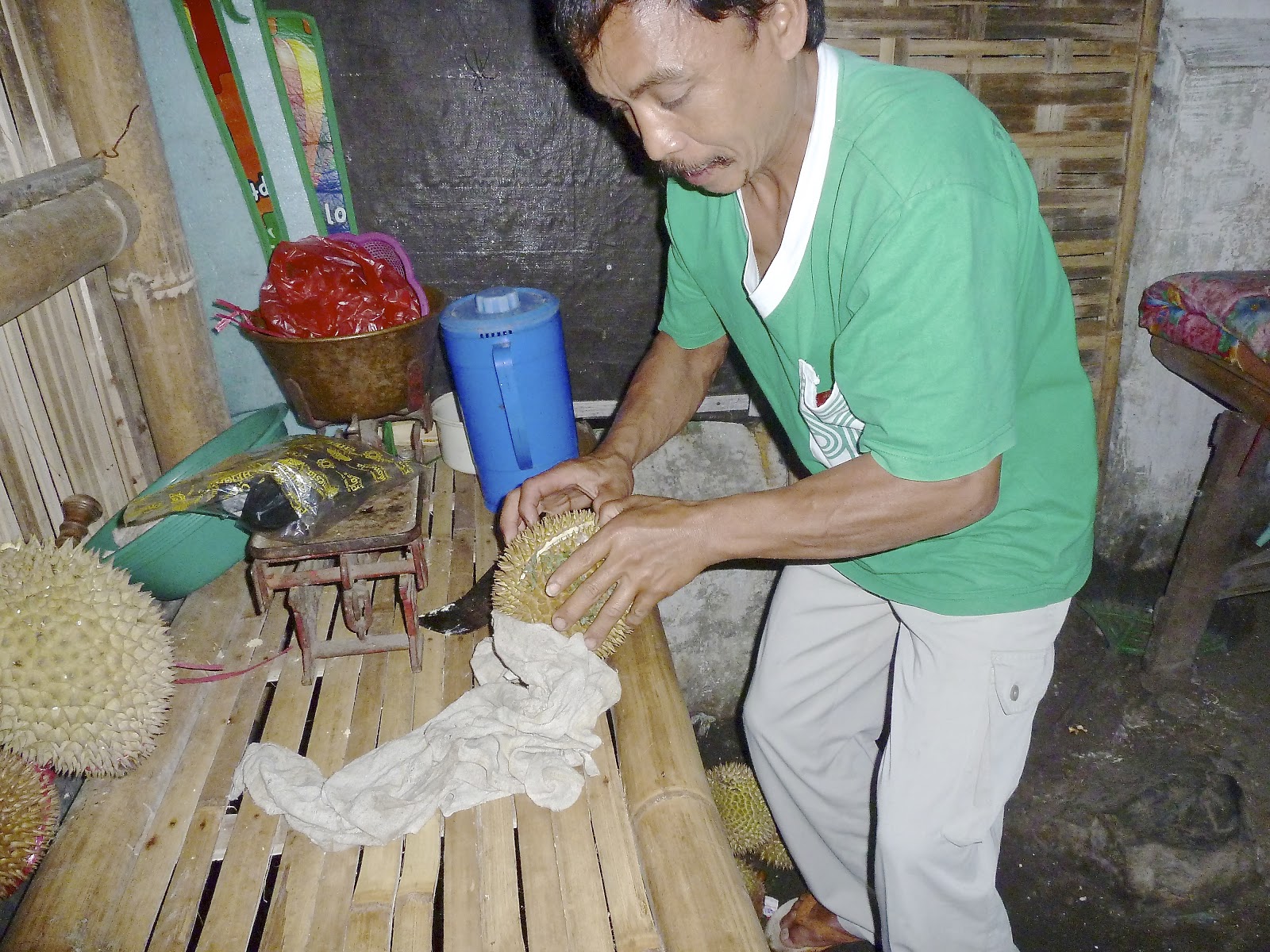

Durian seller prepares taste test,
to make sure we're happy.

We took the durian back to Uncle Tiq’s for a  snack. Taufiq mentioned that this home was very old and had been in the family for generations. I was invited to see the kitchen where Taufiq’s aunt was working. The room was only partially closed in from the elements. There was a pit with burning wood and a grill over it used for most cooking chores. Decidedly old school.

After a bit more conversation and translations, Taufiq said that his aunt was preparing some food and we were invited to stay for dinner. “Your choice of course, but my aunt is a good cook, better than the hotel. She is preparing three different kinds of rice, which is special for you.” I said I would be honored. In a few more minutes we were served a great meal consisting of said three kinds of rice --- local rice, Javanese rice, and rice with corn ---- fried fish, tempeh, tofu, and greens. It was delicious. For a special treat at the end of the meal, Uncle Tiq brought out an unmarked bottle of wild jungle honey. I had a spoonful and freaked over it; so good! Uncle Tiq smiled and insisted I help myself to some more.  

I thanked the couple and complimented Bu on her cooking. After a bit more conversation and a photo moment (see below) we took our leave. I enjoyed this experience so much. What strikes me in retrospect is how easy and comfortable it was, despite the language barrier. This is genuine, easy-going hospitality which is so much a part of Javan culture.

A really enjoyable visit with these warm people. Unfortunately for my photo,
Pak Tiq had changed out of his more traditional clothing.


Sunday, February 24, 2013

FIRE IN MY BLOOD (Addicted to Sambal)


You know you’re truly hooked on something when you begin to miss it even before being deprived of it. Here I am, heading into my last few weeks in Indonesia, and already I’m jonesing for sambal, and using more of it than any sane westerner should.

Sambal is the condiment of choice in Indonesia. It is fiery hot and a tad piquant, and its main ingredients are ground up red chilis, shallots, a bit of shrimp paste and garlic. That’s the basic idea, but there are 300 varieties of sambal across the Indonesian archipelago, some of which use local fruits, spices, palm sugar and other ingredients to create variations on a theme. There is a version called  tempoyak that is made from fermented durian, but I have not encountered it yet. Traditionally, sambal is made with a stone mortar, and restaurants (even warungs) have their own jealously guarded recipes and devotees.

Preparing Sambal (from Wikipedia)

I have always been a hot sauce guy. At home we bring out two or three different commercial hot sauces at lunch and dinner. If we’re not eating cereal or frozen yogurt, it probably has hot sauce on it. When I got to Indonesia, one of my guide books counseled the use of just a little bit of the sambal usually found in a small crock pot or very small round side dish at almost every restaurant, “just to brighten things up a bit.” But Lord help me, it’s a slippery slope. The stuff is addictive, and you find that you need more and more to get that spicy, fiery high. Then you begin to notice that you’re planning meals and choosing restaurants based on the sambal offerings. You will even forgive less-than-excellent food if the sambal compensates. During meals you see friends dipping into their sambal, getting completely red in the face and breaking into a sweat while their eyes are closed in rapture, and you wonder “Did Rowan take it too far this time…” One of my room mates gets take out from a certain place because they have her sambal of choice. It was an ugly scene at the house last week when the restaurant sent her order over without the red stuff. She was an unhappy camper, for days.

So now I’m a bit worried. How will I get along without it? Is there an Asian specialty foods store in Boston that can hook a brother up? And will Tabasco cut it now that the fire is in my blood? Stay tuned.

Friday, February 15, 2013

FEAR IN REVERSE

       I had a real "Aha!" moment this week. Stay with me for a minute on this one.
       I have a new student for a one-on-one class. Let's call him Joko. He's about 40, with a slight paunch, thinning hair and a wispy goatee. He wears round specs on his round face. He looks like a nice guy, and smiles easily. He is Javan at least several generations back, and in my experience, Javans are cultured, circumspect, and very polite.
       Pak Joko works as a project manager for his construction company. They are about to send him to the U.S. for some project work and more language training. He will leave his wife and kids to live in a major American city for three months or so. Does some of that sound familiar?
       The other night, in the middle of a grammar point, Joko looked up and said, "Mr. John, can I ask a question?" 
        "Of course." I waited for a follow-up question on the present progressive tense.
        " I will be living in a big American city on my own. And you know, I am Muslim. I worry a little...will people be nice to me?"
       Pak Joko's question hung in the air for a minute while I remembered my own concerns about coming to live in the largest Muslim country on earth. There had been some anti-Western demonstrations in Jakarta, and my friends and family counseled me to be careful. My memory brought back a taste of the trepidation.
       And suddenly, there it was. A picture of my own fears coming over here as a Westerner, sitting in front of me, "in reverse." It felt like a Higher Power orchestrated this lesson to show me that fear of prejudice is universal, depending only on who you are and where you find yourself.  
       Then my mind went to a video clip I saw recently in The Huffington Post. It showed Terry Jones, the Quran-burning preacher, standing on a soap box in Times Square preaching hate, and soon being drowned out by a crowd that spontaneously sings the Beatles' All You Need Is Love. See the clip here:
http://www.huffingtonpost.com/2012/12/18/terry-jones-all-you-need-love_n_2323094.html
       What would Joko think if he came upon a scene like this? How will he deal with the in-your-face, say-what-you-feel reality of big-city America?
       Wait. This man is looking at me expectantly, and I see vulnerability in his eyes.  How shall I answer his question? How would you answer it?
       "Pak Joko, I felt the same way when I came here. Don't worry. You are a good man, you are friendly, and you speak English very well. Anyone you meet will see your good heart. Besides, there are many different kinds of people in America's big cities, from all over the world. Many Muslims, too. I think Americans will like you very much."
       He nodded, and we went back to the lesson. Did he feel comforted?
       
       Here is an amazing statistic, something that I marvel at daily: since my arrival in Indonesia almost two months ago, I have yet to encounter ONE moment of intentional rudeness from a local person. Indonesians drive crazy, and they don't queue up like Westerners, but they are incredibly warm and unfailingly helpful. They are curious without being aggressive. And I feel very safe and secure. One teacher friend of mine, a Brit who has lived here for nine years, cites the Indonesian people as the reason why he stays. "Yeah, Surabaya is dirty and polluted for sure, but the people...have you noticed how nice they are?" I nodded, and told him I had to admit he was right about that.
         Back to my student. 
         I feel protective of him, even as I know I can't help him once he arrives Stateside. I have faith, though. I do believe people will see Joko's good heart and intentions. 
        So to my American friends: Please. If you see a slightly chubby man with round specs and brown skin, do me a favor and give him a smile. You could be what he remembers about America.


Sunday, February 10, 2013

BYE, BYE BIRDIE ( Hello, Badminton )

       Today I played my first game of badminton since I was about 10.  And I'm already looking forward to next time.

       Some of the office staff at my school have a regular Sunday morning game over at a local indoor facility. I've been fishing for an invite, and it finally came this week. My room mate, who has played with them at "the stadium" before, gave me fair warning about the setting: "You can't breathe. It's a corrugated tin building with no AC or even ventilation. It's just lights and body heat, and that sun beating on the roof. The place is like a sauna. I came out cooked!"


       Well, maybe a tad of an exaggeration. The conditions are not perfect, but they're okay. I must admit, though, that I only lasted for about an hour and a half. My friends said they often play for three hours!


       The thing is, this is such a great game for many reasons. It has all the essential fun and aerobic benefit of tennis, but the relative lightness and slower movement of the shuttlecock (or birdie) make it much easier to play. Arms and legs take less of a beating. Strength is even less of an issue than in tennis. There is more play time and less chasing, since the birdie does not bounce and roll. Like tennis, there is a"net game," with similar strategy. Service and backhand are still important. Essentially, this is an athletic sport that even a non-jock can play.


     Indonesia loves badminton. The national team has taken home gold in the Olympics since the sport was introduced as part of the games in 1992. There are international opens sponsored by Djarum and other private companies periodically; one is happening now in Surabaya. 


    I have two friends who live in Bangkok, and they have taken up badminton with great enthusiasm. They play weekly and have begun taking lessons with a Thai champion. 


     For my own part, I wonder why this sport isn't more popular in the U.S. Or maybe it is, but not in the northeast. Too bad. It makes a wonderful backyard or park game, and can be set up for relatively small money. League play at school yards would make a terrific summer pastime. Children can learn fairly young and with hardly any fear of injury. I hope it catches on.

    In the meantime, I'll be back at "the stadium" next week. I'm hoping to last for two hours. 


Warm-up before doubles


Saturday, February 2, 2013

MEALS ON WHEELS (KAKI LIMA)

     If I haven't made it clear from previous posts, Indonesians like their food, and eat often. Some fried noodles for a snack, gado gado (do you recall? par-boiled veggies and fried tofu with tasty peanut sauce) for a mid-afternoon pick-me-up, and meatballs in soup almost any time.  Of course, convenience is always a consideration when foraging for that next food fix. That's where the kaki lima (literally "five legs") come in.

Kaki lima are food vendors selling from their bicycle carts. The name derives one of two ways, depending on who you believe. One orgin is said to be the 5-foot wide footpaths one finds in Indonesia. Since I have not seen any footpaths, I tend to discredit this option. The other orgin is that the hawker uses "five legs" --- three from the cart and two of his own. 


Local kaki lima sells Chinese won tons in soup.
He keeps a very clean cart.
In my neighborhood there are many kaki lima and they work tirelessly all day, often past midnight, and in all weather conditions. When there is a construction site in the area, or a busy mosque, they will arrive before lunch, park themselves in the nearest shade and set up for business. Some carry fuel to fire their wok or soup. They often carry ice to refrigerate or for drinks. While they pedal around the neighborhood, each has a distinctive and traditional sound they use to announce their presence. The bakso (meatball) vendor bangs a pot with his spoon. The chicken and noodles guy hits a wood block and produces a "thunk-thunk" sound. The bread guy actually has a recorded jingle he plays. The satay man sings a musical cry, "Saaa-tay." I have also seen kaki lima selling fruit and ice, roasted corn on the cob, fried rice with chicken and vegetables,  and assorted fritters (Indonesian corn fritters, flecked with red chili, are to die for!).

What about eating at a kaki lima? I must admit, I haven't yet. I hear the gado-gado guy by the school is terrific, but he runs out quickly and I haven't timed it right. And the roasted corn has eluded me. The meatballs are...sketchy, and they've been in the sun for hours. Ugh. Noodles, porridge and soup might be good, but so far I've shied away.


The locals certainly don't, though. About 6 pm, there are several of these hawkers doing a brisk business in front of our school, serving at outdoor tables, washing dishes, cooking and transacting. The teachers run out and chow down in between classes, usually for just a dollar or so. 


Come to think of it, what am I waiting for?


Lunch time in front of the mosque.
His cart is called "Meatball Love."


Tuesday, January 15, 2013

ANAK ANAK BAIK BAIK (The Kids Are Allright)


My English students here are roughly 9 to 18 years old, and some of my classes have ten or so students in the 9-10 age group.

I certainly did not plan things that way. First of all, I have never taught anyone anything at that age. My students in the US have all been mature adults. Secondly, I must be honest enough to say that I am not a person who is initially drawn to all children all the time. John is not the guy running up to kids in public places to engage them or cooing at toddlers in stores. Up to now I would say that for me, the connection happens or not on a case-by-case basis. It depends on the child and my mood. Lastly, as I get older I notice an increasing desire for quiet and perhaps a decreasing amount of patience in my reserves each year compared to the year before.

To be fair, when I came to Surabaya, my job description certainly included the possibility of teaching youngsters. But I thought that given my own age, background and experience, I would probably be charged with other duties. I was wrong.

Now here’s the surprise: I really like the kids, and I am absolutely fine with teaching them. In the great majority of cases, Indonesian children are polite, smart, receptive to learning, and ready to engage. Of course they have high energy. They get excited and bubble over sometimes like all kids do, but they respect the teachers and will calm down with “settling activities” --- like drawing--- which we teachers carry in our bag of tricks. The kids are very often adorable and sweet, and they want to teach you about Indonesia and their world. Sure, there may be one or two exceptions I can think of, where a kid is often disruptive (due to over-indulgent parents, perhaps). But truly, these are very rare instances, and they can be managed.

Last week I substituted for another teacher who was on holiday. The class was young, maybe eight students aged10-12. The lesson was about local customs for holidays and birthdays, and the children could not wait to tell me about theirs. When we played a team game, they supported their teammates, and showed natural sportsmanship. At the end of the class, each of the students came up to me on the way out, said “Thank you, Mr. John,” took my hand and pressed it briefly to his forehead. I was touched, as you can imagine.

Outside the classroom, I notice that Indonesian kids from all walks of life are naturally curious about me as different from what they usually see. If they stare at me I wink at them. And because they are not inhibited adults,  they will often approach me for a brief interaction. These moments are usually lots of fun.

Last week in a department store I was paying for an item at the checkout counter when a young man, about 9 or 10 ran up to the counter and said “Hi, mister.” When this happens I usually bend down so we can be at the same height. “Hey, buddy. How are you today?” We chatted for a minute, and then his father came over with his other, younger son. “He wants to practice his English with you.” I told him his boy had great energy and personality. Turns out he is an aspiring drummer. I turned to my new friend, told him I played the guitar, and maybe we could play sometime. The younger boy didn’t want to be left out, and followed me as I was leaving his father and brother. I stopped again and we talked a minute also. Then smiles and waves all around. It wasn’t a big deal, but they were all so pleasant and made me feel like a celebrity. Just a nice moment.

Obviously there’s a lesson in all of this. Keeping an open mind and not pre-judging the work of teaching children gave me the opportunity to discover something new about myself. It opened up the possibility of enjoying an experience I did not naturally relish. In a way, it sort of “jump started” or renewed my relationship with a segment of the population I don’t interact with often. And it broadened my work world and ESL resume.

All in all, another small gift from my time in mondo Indo.


As I finish this post, outside dusk is falling under a soft rain, and the call to prayer from the local mosque is being chanted over its loudspeakers. Thanks for visiting here, and please check back soon.

Sunday, January 6, 2013

JOYS OF YOGYA (Part 2)


Yogyakarta is an excellent tourist destination for many reasons, but I would list reason #1 as accessibility to a great number of varied tourist experiences, both inside and a short distance outside the city. There are organized tour options available from agents downtown and at the hotels, or hire a car and guide for relatively short money.

Just 25 km north of here, the Merapi volcano towers over the city, a perpetual object of both fear and reverence for Javans. This is the most active volcano in a country of many, and thousands of people live on the flanks of the mountain despite a very real danger of eruption. The volcano emits smoke most days of the year, and serious eruptions in 1994, 2006 and 2010 resulted in pyroclastic flows and death tolls. There is new museum and tourist site on the mountain side where you can hire a 4x4 to tour the areas impacted by the 2010 eruption.

Gunung Merapi ("Fire Mountain")
Perhaps the most beautiful place I’ve seen since arriving in Indonesia is Borobudur, a spectacular Buddhist monument constructed in the mid 9th century, at a time when Java was ruled by a Buddhist-Hindu dynasty. It is built from two million stone blocks in the form of a large symmetrical stupa, with square platforms topped by circular platforms in a distinctive design. There are 2,672 relief panels showing scenes from the life of the Buddha, and 504 statues of the Buddha. A great part of monument’s beauty is its location, literally wrapped around a mountain, with green terraced rice paddies and soaring volcanic peaks in the distance. No wonder this is Indonesia's most visited sight. Borobudur benefitted from a UNESCO restoration in the 70s, and was made a World Heritage site in 1991.
The "skirt" was required, not sure why

Borobudur panorama


As part of my tour of this area I visited the local agricultural village of Candirejo, where a new home stay program has been developed to give young people an idea of day-to-day life here. A young man showed us around by horse-drawn cart. There were ripe rambutan fruits to pick and eat off the trees, beautiful rice paddies, and a small cassava chip production facility (these salted, fried chips are extremely tasty, especially warm out of the fry pot!).
through the fields in Candirejo
The temples of Prabanan are just 17 km from Yogya, on the road to the town of Solo. These also were built in the 9th century, before Java was converted to Islam. The largest and finest temple is dedicated to Shiva, with lavishly carved “medallions” depicting scenes from the most well-known  Hindu epic, the Ramayana. The other memorable temples are those to Vishnu and Brahma. All are outstanding examples of ancient Hindu art. Prabanan is also much less of a tourist destination, which makes visiting a bit easier.
At Prabanan, in cognito as one of The Village People
All of these sights can be conveniently combined with others for a good day trip, but do consider at least two or three days in the area. Farther afield, in Solo city, there is a beautiful palace and kraton with displays of dance masks, jewelry, and gifts to its sultan (but these cannot rival Yogya’s kraton). Across the street from the kraton in Solo is a small antiques flea market called Triwindu, which is fun and very inexpensive from what I could see. Finally, an old Dutch enclave in Solo called Kampung Laweyan constructed in 1546, houses a warren of small cottages that have their own boutique batik businesses. Most of these are generations old. Here you can see batik being made and buy the finest quality for a bit more than wholesale.

Well, that’s some of my trip to Yogyakarta. I didn't get to write about Parangtritis Beach, Kasongan pottery or the herbal medicine called jamu, but maybe at some later point. I encourage all travelers to Indonesia to spend some time in Yogya to taste the rich flavor of Jawa (“Java” in Javanese). It’s a great city, with plenty of fun things to see and do, even on a budget.

Thanks for reading!